


We Were Not Created for Marriage: A Call to Grace Over Judgment
There is a conversation happening quietly, and sometimes not so quietly, in many church pews, WhatsApp groups, Twitter, and family gatherings. It usually targets a specific kind of person: the one who came to faith later in life, carrying visible scars from their past. The whispers follow them down the aisle. "She only came back to church to find a husband. He is just here because things fell apart." We dress our suspicion in discernment and call it wisdom. But it is worth pausing to ask a more honest question: "What, according to the scripture, were human beings actually created for?" And does our treatment of repentant sinners reflect that answer?
The Primary Purpose Was Never Marriage
Let us settle this at the foundation. "The Bible does not present marriage as the chief end of human existence. From Genesis to Revelation, the consistent thread woven through scripture is this: humanity was made to know God, to worship Him, and to walk in relationship with Him. When Jesus was asked to identify the greatest commandment, He did not point to matrimony. He said, "Love the Lord your God with all your heart, soul, and mind" (Matthew 22:37). Marriage is honoured in scripture, it is a covenant, a gift, a reflection of Christ's relationship with the Church, but it is not the summit of human purpose.
This distinction matters enormously, because when we elevate marriage to that summit, we distort how we receive people who walk through our doors. We begin measuring their motives through a matrimonial lens instead of a spiritual one. We forget that the door they walked through leads first to God, not to a spouse.

Repentance Is the Point of Return
The Gospels are strikingly consistent about what draws heaven's attention. It is not a perfect attendance record. It is not an unblemished past. It is repentance, the turning of a heart back toward God. In Luke 15, Jesus tells three parables in succession, each centred on something lost being found: a sheep, a coin, a son. In each case, the recovery is met not with interrogation but with celebration. The shepherd does not return with the lost sheep and immediately quiz it on where it has been. The father does not meet his returning son at the gate with a list of conditions.
What is striking about the parable of the prodigal son is not just the father's welcome, it is the completeness of it. The son who had rehearsed a speech about unworthiness does not even finish delivering it before the robe is being placed on his shoulders. This is the picture Christ chose to illustrate how God receives the repentant. It is extravagant. It is disproportionate to what the son deserved. And it is entirely intentional.
If this is the character of God toward repenting sinners, what does it say about us when our first instinct is suspicion?
Consequences Are Real, But They Are Not Our Assignment to Enforce
This is where honesty demands some nuance. Grace does not erase consequence. The prodigal son returned to his father's arms, but the inheritance he had squandered was gone. The text does not record him receiving a second share. The years spent in that far country could not be rewound. Real decisions produce real outcomes, and pretending otherwise would be a disservice to anyone navigating the aftermath of difficult choices.
However, and this is critical, the existence of consequences does not make the community of believers the appointed enforcer of those consequences. There is a meaningful difference between life naturally bearing the fruit of past decisions and the Church actively piling on. When we remind someone of where they have been every time they try to move forward, we are not being realistic. We are being cruel, and we are disguising cruelty as principle.
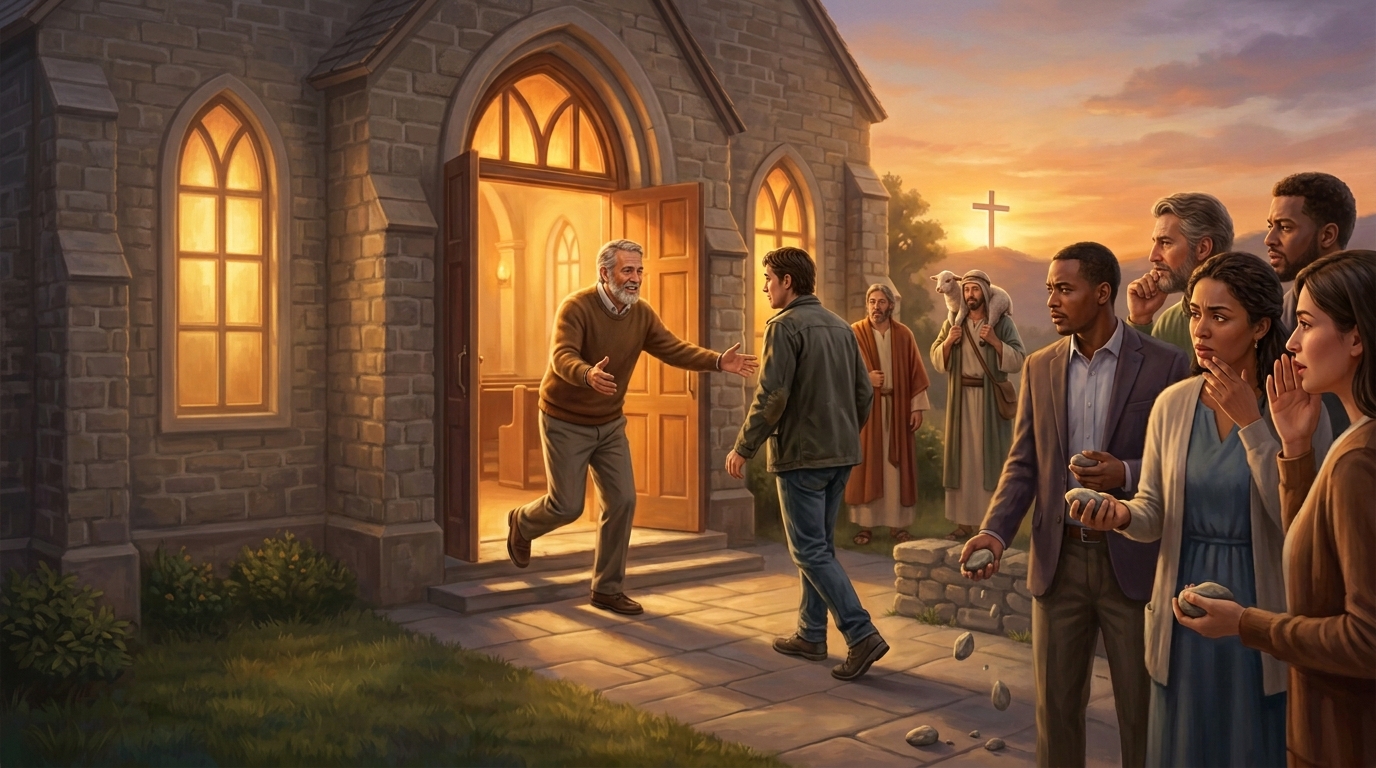
The woman caught in adultery in John 8 was brought before Jesus by people who were absolutely correct about what she had done. Their facts were right. Their verdict, under the Law, was technically defensible. And Jesus did not dispute the facts. What He disrupted was their self-appointed role as executioners. "Let he who is without sin cast the first stone." One by one, they left. He told her to go and sin no more, not to go and be punished by others first.
The Danger of Becoming the Elder Brother
The parable of the prodigal son has a character we often overlook: the elder brother. He is the one who stayed. He kept the rules. He did not squander anything. And when his younger brother returned to celebration and a fatted calf killed, he was furious. His complaint was not entirely unreasonable by human standards. He had been faithful, and it felt like faithfulness was going unrewarded.
But notice what his attitude produced: he stood "outside the house". He refused to go in. In his moral bookkeeping, he lost something far more precious than an inheritance, he lost the joy of his father's house, and he distanced himself from the very relationship he thought he was protecting through his obedience.
Many long-standing believers risk becoming the elder brother. We can be so invested in the record of someone's past that we become resentful of their restoration. We police motives we cannot see. We assign interpretations to behaviour that may have nothing to do with the truth. And in doing so, we position ourselves outside the very grace we claim to represent.
Love Is the Strategy, Not the Sentiment.
When Jesus said in John 13:35, "By this everyone will know that you are my disciples, if you love one another," He was not making a poetic suggestion. He was describing the primary mechanism by which people are drawn into and retained within a community of faith. Love is not merely the right feeling to have toward new or returning believers. It is the practical method by which they stay.
Judgment pushes people away. It tells them that the Church is a place where their worst days will be their permanent reputation. Grace pulls people in. It tells them that what they carry when they arrive is not what will define them going forward. If we are serious about people remaining in the fold, not just showing up once and disappearing, then how we treat them in their early, vulnerable, reconstructing days is not a secondary concern. It is central.
A Final Word to the Believer
We did not arrive at faith unblemished. Every person sitting in a congregation came through a door marked 'Grace', regardless of how long ago they walked through it. The call placed on human life, to repent, to worship, to love God and love others, applies to the person in the front row who has been there for forty years, and equally to the person in the back row who arrived last Sunday for the first time in a decade.
Marriage may be a beautiful part of many people's stories. But it is not the reason we are here. We are here to return to God, to grow in Him, and to carry one another along the way, not to audit each other's reasons for showing up.
Put down the stone. Open the door wider. The father is already running.
Related stories


Leave A Reply